Expectations and Empowerment bizarre possibilities.

So what if the goal is to enable the empowerment of staff, how can we possibly accomplish this when human nature and culture on the whole is risk averse?

Most of us expect negative results when we fail, this is basic survival. Yet we also know that the greatest rewards are often obtained when we seek opportunities and stretch outside comfort zones. These less travelled paths often are avoided because of the risk of failure and the expectation of “punishment” or negative results. The strange thing is, that as companies become larger they are often forced into previously unfamiliar territory. This very risk is often were the benefits lie.

Yet in an established hierarchy the management and staff often feel that it is better to remain inert rather than proactive and acting upon possible opportunities. We have negative expectations when we see opportunities. Often even though the answers are obvious and easily implemented, we stand idle because it’s outside our pay grade or we want/need higher management permission to enact any action or change.

This form of initiative blockage is systemic in most work environments, so how could we get around this blockage? The answer may just be as simple as the problem. We use a “get out of jail free card” strategy. If you give your management team or even expert staff an exemption card, if something goes wrong during a project they could utilise it and the entire issue is for all intents and purposes a blank slate, written on a piece of paper and thrown in the bin, never to be remarked upon ever again. This reset, enables the expectation that even if things do not work out for what ever reason then the risk averse bias is negated to a certain extent by the exemption card. Obviously this is not meant to be carte blanche but a method to alleviate the bottlenecking and allowing staff of all levels to maximise opportunities, developing skill of evaluation and risk assessment along the way, all within a professional framework.

Expectations Pressures and Self

The word expectations invokes different things for different people, yet most of us see it as a negative. Comments like “What did you expect?”, “Don’t get your hopes up.”, “Manage your expectations.” sound all too familiar. They all cast expectations in a negative light to varying degrees.

So why do we dread expectations and see them in a negative way? The simple answer is FEAR, the most basic driving force that we humans seem to indulge in on a daily basis.

Fear of failure, fear of being let down, fear of not being good enough and the list goes on and on.  The interesting fact is that we divide expectations and fear. By pulling these two intertwined threads, we obscure the reason for our dread of expectations, which is due to our internal fears and the way we perceive others will see us. I leave you with that thought, give it some pause and contemplate how fear impacts the way we behave.

Expectations, pressure and self, heavy stuff but basically both expectations and pressure are impacted by the latter, Self. We all make our own reality and in doing so sculpt the perspectives of others.

The word expectations predominantly has a cautionary negativity about it but it is also seen as an external force. I know that expectations commonly are exerted upon us from the outside, project, boss, peers, family….etc. Yet we overlook, the more important expectations those we carry within. We all carry these expectations of Self but we tend not to acknowledge them.

Small children tend to have no real fear of failure or how others will see them. How often have you heard a small child say “I can do that !”, even though they have never done it before? They are not inhibited by expectation either external or internal, they carry a self expectation that they can do anything and be good at it. Adults on the other hand become nervous and fearful of any potential failure, tending to exert massive amounts of stress upon themselves and adversely impacting the experience and even the outcome at times.

You see self-expectations are often overlooked but I believe they are the most powerful of all expectations. The image of self and how it impacts our behaviours and responses is a vast topic, I will not go into detail here but I will hopefully cast some light upon the issue, so as to help you along the path of self awareness about the Self-expectations we all carry.

These self-expectations that we have, often limit our advancement and stifle our ability to succeed. How often have we hesitated despite the obvious. This can be seen often in a career path where we settle in and get comfortable. We expect that comfort, and this feeling of comfort should be there, all the while slowly becoming oblivious to the need to stretch ourselves, so we can grow and feel a sense of accomplishment.

I’m not just talking about our salary or pay, although this is a very common symptom of the self-limiting expectations but the growing dissatisfaction from our own fear driven self-expectations. If you feel you could contribute or do a task better, why don’t you? The instinct is to keep your head down and bum up but at what cost to yourself and the group. The loudest and most assertive among us are not always the best suited to the task at hand.

Yet often we down-size our expectations to suit our comfortable stride.

Game play – a Management Insight

The whole idea of modern management can be distilled down to a single basic goal to maximise profit, the methods in which a company or business pursues this most basic goal can vary substantially, focusing upon different areas such as efficiency, staff satisfaction, R&D (Research and Development) and the list goes on.

For the purpose of this discussion the method chosen to achieve the basic goal of profit, is irrelevant.

I want to focus on a method of decision making that we are all familiar with, yet underutilise in our work lives. The process is that of game play and in particular the games of Yahtzee and Poker. The simple fact is that in our management we forget that there are not only outcomes but multiple outcomes from any given situation. These actual outcomes may or may not be desirable but they are equally valid regardless.

The reason I’ve chosen these two games to highlight my point is that although both games are games of chance, they are also games of skill, relying upon probable outcomes of particular desired patterns.

The game of Yahtzee is based upon poker with dice, the general game play is a simplified and modified poker variant. Yahtzee does not allow for the ability to bluff as in Poker which makes it less human but more instructive for my example.

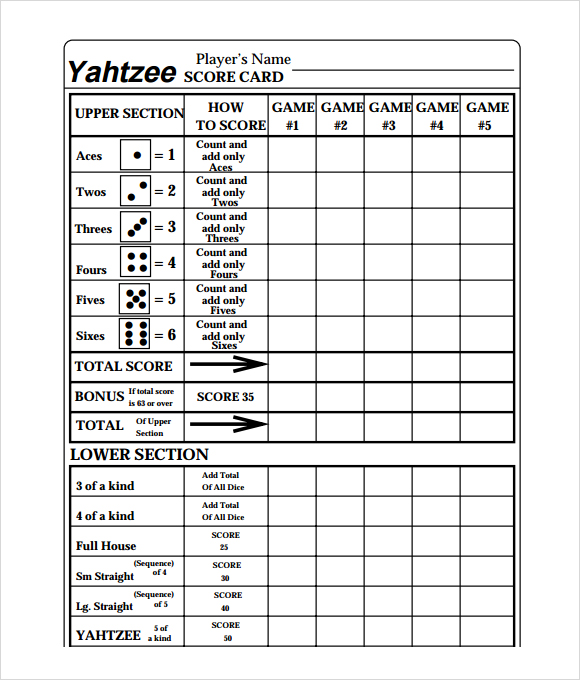
YahtzeeAs you can see from the Yahtzee score card to maximise your score every box (category) must be filled with the highest possible score. This is where the management part comes in because when you get say three or four of a kind you need to allocate that roll of the dice, for the highest yield. You have to decide if the three 6’s you just rolled should be scored as either a three of a kind or three 6’s. The fact that three 6’s is the highest three of a kind possible is going to bias your decision, in this case, so you place them in the three of a kind category but if they were 4’s instead. Three 4’s is a good score for either category, and it depends where you are in the course of a game. You begin to see the point?

There are definite probabilities for each potential outcome and obviously the more difficult, lower probability, ones are the highest rewarding. However, if we focus on only getting the highest possible score for each scoring outcome we soon find ourselves in a losing situation. Each roll of the dice must be recorded and accounted for so aiming solely for Yahtzee (5 of a kind) will result in poor scores because that blind focus will mean other options will be ignored.

So what has this got to do with management, well projects can be considered outcomes just like a hand of cards or a roll of the dice in Yahtzee.

When we ask for a piece of work we expect to get it, yet in the real world we rarely get what we expect and in fact may not get it on time or at all. The delivery may be postponed because a part of the work has not been completed, requirements change over time. This can happen quite often and is one of the reasons we do risk analyses. Yet if we remove the original expectations, we may realise we have created a very worthwhile component which would not be delivered because it is not the expected/requested whole but could fit into and/or compliment another project. Just like in Yahtzee holding onto the original expectations may lead to a reduction in movement towards our goals.

When we manage we tend to focus upon expected outcomes and unexpected or below expected outcomes are disregarded or thrown out.

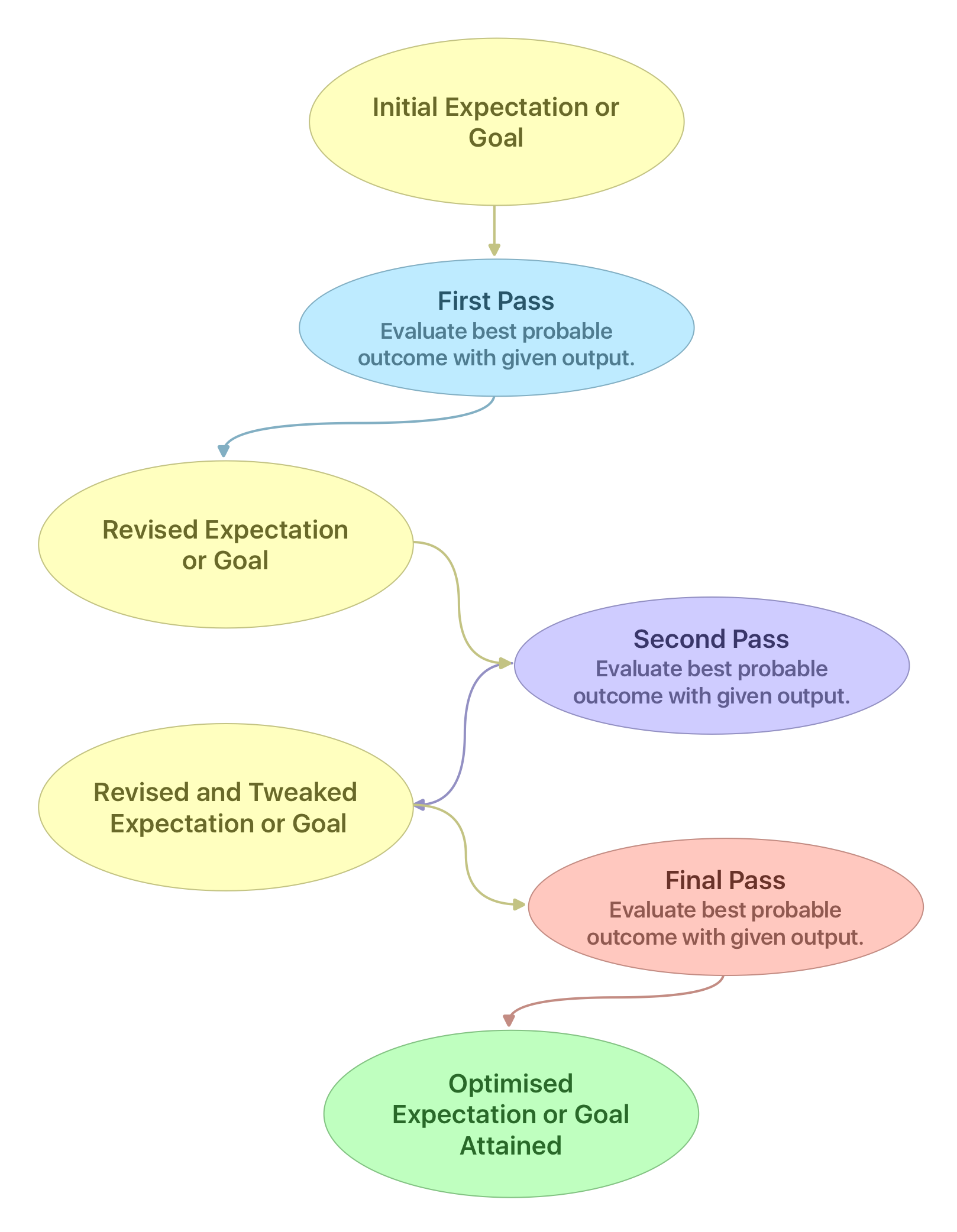
Both Poker and Yahtzee also share the fact that the initial hand or roll can then be cherry picked and tailored to achieve the best outcome available with what was given. Then the parts not suitable for the newly scoped goal are discarded and re-drawn or cast. This happens three times in Yahtzee and one, two or three times in Poker depending on how many draws are allowed.

Adaptive Management FlowThe simple fact is that maybe the three 1’s are better scored in the one’s category rather than the three of a kind box. The old make lemonade when life gives you lemons approach. We rarely get what we expect, so if we are open to see the possible benefits of a given outcome disregarding our expectations then maybe we will have more wins.

I suggest that we use the mind set of reiteration and liquid goals as seen in Yahtzee and Poker as a possible management methodology, examining components and maximising their utilisation.

Planning and Focus

Plans are great!

  • They help us focus and align to a goal
  • They demonstrate that we know what we are doing
  • They help us to break up work into manageable chunks so that we can deliver in stages or divide the work up between teams

But…

What if the goal is to achieve innovation or find new ideas?

Let’s take the 3 points above and see how they might be detrimental when we are dealing with complexity as defined in the Cynefin Framework.

Focus and alignment

When we focus we can miss things. Try staring at something nearby now – focus on its attributes and why it is there. Notice that while you are focussed, other things become less noticeable in our peripheral vision, hearing and other senses.

In an ordered environment, where things are knowable and there is a high amount of certainty, focus is a wonderful thing.

In an unordered environment of complexity or chaos it can destroy us in the worst case – and in the best case it will limit our ability to find new ideas and interesting things. We still need to have an idea of what we are looking for, setting some constraints or boundaries – but it is not a laser-like focus.

We know what we are doing

People who use traditional planning methods in complex environments do not know what they are doing. The planning needed in complexity is how to manage constraints, how to identify ‘good’ and ‘bad’ patterns and how to amplify or dampen them respectively. Risk and opportunity management methods are much more appropriate in complex environments and traditional planning is great in ordered domains.

PlanningPlanning

A person who knows what they are doing will use both types of planning/management, mixing and matching as they go.

Unfortunately, people are traditionally rewarded for showing how they executed to a plan and achieved an outcome. In this light, the outcomes achieved in a complex environment can only be described after they have happened. So it can look like random luck and is not generally well rewarded unless the outcome was an astonishing breakthrough or innovation of some sort. In these cases we will backfill the story in a retrospectively coherent way so that it seems the achievement was planned that way all along.

Retrospective CoherenceRetrospective Coherence

Divide up the work

Absolutely the best way to do something in the ordered domains. Break it up, build each part and then assemble it at the end.

When we try to do this in a complex environment we spend a lot of effort trying to get certainty. We also highly constrain the outcome to only that which we imagine is possible at that point in time.

So not only do we spend too much, we also sub-optimise our opportunities.

The better option is to explore the needs using test and learn approaches. Techniques for exploring the ‘fuzzy front end’ from design thinking work well as does prototyping, experimentation, articulation of assumptions and then validation or invalidation of them.

This is where we say that failure is good – let me explain that because many people have issues with such a statement.

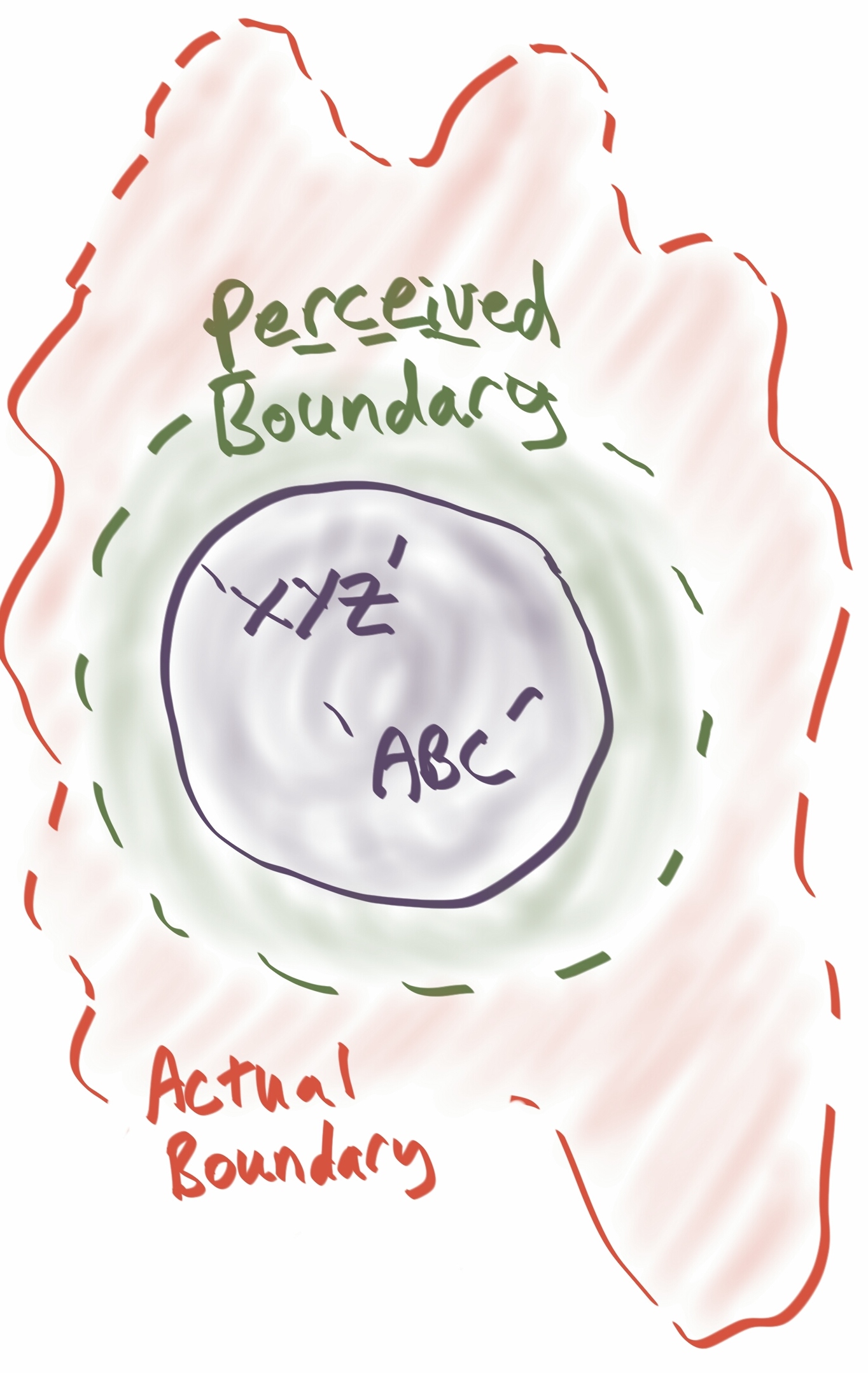
When we are in a complex environment we do not know and cannot predict what will happen when we do action ‘XYZ’ and there are many actions that we could do. In order to find out what works and where the boundaries might be, we conduct experiments to see if there are stable and repeatable patterns. The experiments that work are what we are seeking and the ones that fail are outside of what we are seeking. Only by conducting experiments that fail can we be confident that we have found the edges of the space that we are exploring. If we don’t get failures, then we have not gone far enough and have missed opportunities for new ideas that might work.

BoundariesSo safe-to-fail experiments are important and the above helps to explain why we should be designing experiments that we expect to succeed and ones that we expect to fail – when do this we are guessing where the boundaries exist and the experiments confirm those boundaries.

Summary

These 3 examples demonstrate that our traditional planning and focus methods are really only suited to the ordered domains in the Cynefin Framework and that seemingly ‘opposite’ approaches are more effective in the complex domain.

We need more innovation and new ideas – we will not get them using standard planning and focus methods.

Plans are great – when we have certainty and predictability (and not when we want new ideas).

We all want it

We all want it,
but we rarely get it.
We rarely show it,
and don’t know
what to do with it.
Yet worst of all
We only find it
When it’s gone …….

What is it ?

Well it could be a few things but to me it describes Appreciation.

We all have been on both sides of this one. A valued member of a team leaves because basically they weren’t appreciated in their present job and all that we’re left with by their absence is a sense of “I’m going to miss them.” or “they were a valuable member of our team”. …….Too little, too late.

What makes Appreciation so difficult ?

The innate need to feel self-reliant and our own person is at the root of many strange and bizarre human behaviours. I consider the inability to give and indeed receive appreciation a side effect of the increasing cultural trend of self-first and self is all. The interesting shift regarding one’s self image is part of a greater capitalistic movement. The way you define yourself is an interesting exercise; I is prevalent, we are ego centric, the three most important people are Me, Myself and I. The constant self-evaluation and keeping up with the Jones, means that the trend is to move towards self-orientated behaviours. In fact, the mantra of entitlement and selfishness has been heavily espoused as the way of the modern world. I wonder but at what cost.

The strange paradox which appears, is a situation where selflessness and even an altruistic philosophy is facing extinction. How many of us have happily accepted help and or support from a fellow worker or anyone for that matter.

Now let’s say, you begin a company and you need a web presence, email etc. These things are provided by a third party, friend or relative at no charge to you, just to help you out. During the course of a few years, the inevitable server issues pop up and are dealt with. The company is moving along at a reasonable pace, tenders, projects and the general life blood of the company is reliant upon your email addresses and hosting of your website. Now the rub, we all require to be appreciated when we are working, this in its basic form is your pay packet. The fact is your wages or salary are the most tangible way our society shows appreciation.

What if there is no pay, how do you express your gratitude and appreciation?  Should you? Once we lose the structure of a work for pay contractual environment, we waiver and fall because we are now in unfamiliar territory. But why is it unfamiliar?

The sad truth is even the simple act of gift giving has been infected with the economic comparisons of our modern society. Is the gift expensive enough? Is it too expensive? What happened to “Will they like it? Or Appreciate it? Somehow, appreciation has become an economic value. Common sense would dictate that if someone spends 20 hours working for you; a cup of coffee may not be seen as appreciation but it’s a start. There is a very obvious scale to the effort involved with anything, just because someone is happy to help don’t take advantage or abuse the fact.

The situation above will eventually result in an alienation of the third party, the image of self-dictates that the person doing the web hosting for free, must be happy to do so or they would not have offered. Conversely if it bothered them they would say something. The simple fact we are blinded by our own inability to see the effort from the other side when it suits us, is obscured by ego. The fact that your company is doing well has nothing to do with the free web hosting or the email addresses. The ego will not allow the possibility that we are beholden to someone other than ourselves for our success.

The sheer arrogance of this position is staggering. We only exist because of the effort and sacrifices of all those that came before us. Without our ancestors we would not exist, we stand on the shoulders of all that has come before. Yet in the modern world I made it happen and we all can be incredibly wealthy and successful. The modern world rewards us and those who fail or underachieve make their own fortunes. The helpful person is there to be used and abused so that we can spring board to success. This is a very dark and bleak path we are on and not the world I choose to live in. Does it mean I don’t get used? No. Does it mean I don’t help? No. What it does mean is I give the benefit of the doubt, a total of three times. I call this baseball rules, three strikes you’re out. I consider three chances more than enough.

So next time you help someone and expect a little acknowledgement for the effort you have made, try to remember how you responded when others helped you. You may find you did not show or express your appreciation and then be wondering why no one seems to offer aid anymore.

The cost of appreciation seems too great for our modern society and appreciation without capitalistic embodiment so rare we don’t even know how to identify it. I wonder how hard it is to say thank you or buy someone lunch….it may just kill me?

Quantum Discussions about Decisions

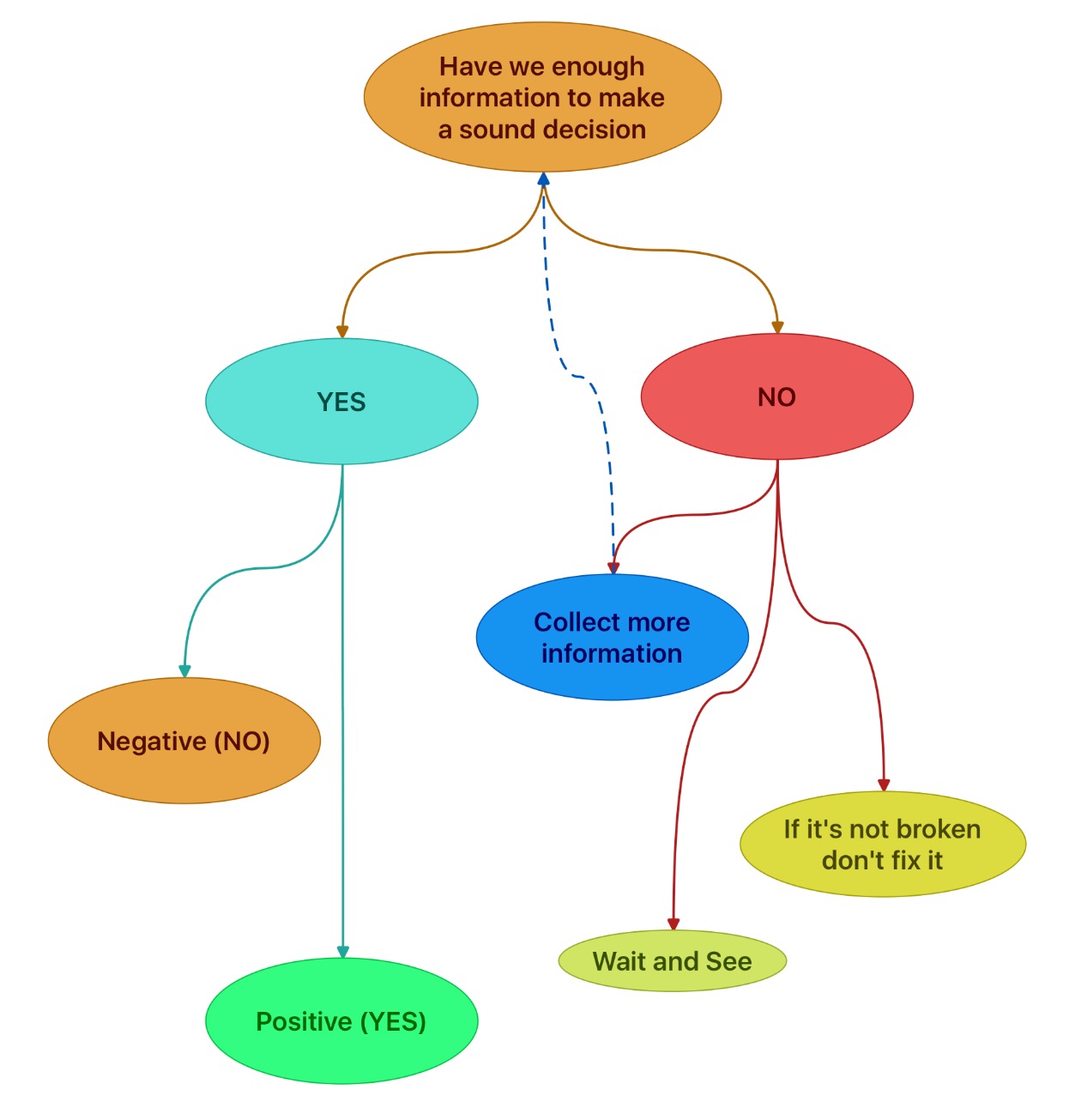
I have often been amused by the way most people consider the world to be binary. Their lives are mapped out in Yes / No options. We are often presented with or present to others questions or tasks that we expect to get either a yes or a no answer. In fact our cultures seem to be built upon the very idea that we need to know either yes or no. Yet the simple fact is that our world is not a binary one (Yes/No or 1’s and 0’s) but a far more complicated one. The realm of quantum mechanics, Schrödinger’s cat and the quantum states.

To understand we constantly search for simple correlations and then collate like facts or events. This is commonly seen in the way we pigeon hole ideas, thoughts, facts etc.. Yet by doing so we also reduce and strip away the “individuality” of the particular item or event. If I say rock concert then we all form an image of a typical scenario we consider to be a rock concert. The fact is that unless more information or context is provided then we could all see the rock concert as a completely different thing, a vast range of possible outcomes.

This is sort of the realm of quantum mechanics and computing because it becomes more about probabilities than about definitive out comes. Monte Carlo simulations also spring to mind as ways we can cope with the lack of definitive or binary outcomes in decision making.

I have long held that although we tend to fall back into the comfortable binary, Yes/No decision protocols we often ignore the neutral or zero state. I suggest that instead of a binary (0 or 1) protocol we should be aware that many things fall into a “trinary” (+1 or 0 or -1), yes three possible options. To highlight this consider driving forward, you can turn left or right but you can also continue forward. Often the basic need to feel empowered in our lives makes us see the world in a yes or no manner, yet we could also decide to not make the decision and wait and see. The wisdom of this is often obvious “if it’s not broken don’t fix it” or the “wait and see” philosophy.

So next time you feel you have to make a decision, ask yourself is the zero state actually a more prudent option ?

You must also consider that the trinary protocol’s Zero state is not mutually exclusive of the Yes or No options but actually allows for the possibility of greater clarity and reflection.

If it helps consider it a reiteration of a binary loop.

Decision Pic

Now this is not really as complicated as a true quantum method of decision making, I’ll leave that for the more Monte Carlo inclined people among you but it is a good place to start.

Be Water

In team dynamics there is a lot of discussion about personality types and behaviours. I suggest that all of these points of view although valid and interesting are all flawed to some degree because they all make assumptions and have inherent biases about the people involved. These assumptions and biases may be subtle yet can be highlighted by the simple question “How would you describe or define yourself ?” That’s easy to answer or is it? How many people can objectively answer honestly and without any bias?

This blog is meant to shake up and loosen the firm grasp that any previously held beliefs about group dynamics, personality types and their driving behaviours have upon us. I hope to highlight and to help clarify the complex interactions that are involved in groups.

The basic premise that personality is set and therefore the patterns of our behaviour are also equally constricted is mostly true yet flawed. While I was exploring the field of Chinese Astrology I came across an out of print book …… which highlighted at its very beginning that your astrological sign predisposes you to certain characteristics and behavioural tendencies. Yet the awareness of these predispositions, can help the person make a conscious effort to modify or even alter their own character and behaviours and therefore their destiny.

Whether you believe in astrology or not, doesn’t matter but the lesson that the human animal while predisposed to certain behaviours and traits, has at its heart the ability and possibility to modify and even alter these behaviours and therefore outcomes, is valid.

Martial artist Bruce Lee in a 1971 interview on the Pierre Berton Show, stated that his style was fluid and changeable. The example he gave was that water took the shape of whatever vessel it was poured into, it was not ridged or set but easily adaptable and therefore all forms and yet none at the same time. Lee’s fighting style was the same, taking and modifying many martial arts and adapting and changing fluidly during the course of a bout. The lesson he taught was to be water, adaptable and fluid.

So what does this have to with team dynamics ?

Well, we are all predisposed to certain traits, characteristics and behaviours, a group by its very nature is composed of different people. Sometimes the group will naturally form, people gravitate towards each other, seeking out like-minded people. Other times the group will be constructed by a lead or manager trying to find a blend of personalities and character traits that work well together, an equilibrium, at least on paper. Regardless of how the group is formed they all undergo, what I call “balancing“. The process of balancing can be at the people level, which is what most group/team dynamics seem to focus upon or as I believe also at the individual level.

Balancing can be seen by the dynamics in a group where the strengths and weaknesses of some individuals counter balance those of other group members. In fact it is this very interplay and dynamic which enables group bonding through interdependencies. These interdependencies in a well-balanced team are bidirectionally rewarding giving a sense of belonging, security, worth and need.

This balancing can be seen easily in the interactions between individuals but there is a more subtle balancing that occurs which is less obvious. The concept is actually rather common but not really readily acknowledged, internal balancing.

We have all experienced someone who behaves differently around a certain group of people or have maybe even done it ourselves? I’m not talking about the “two faced” type of behaviour which is unfortunately becoming rather common place in today’s culture, as a means to rapidly climb the career ladder. “How to succeed in business without really trying” was a great comic film on the topic.

I’m talking about the often subtle character shifts and even changes we all make when dealing with relationships. This is often more easily seen in personal relationships where compromise and modifications of traits and behaviours take place even subconsciously during the time of interactions. The blatant Boys night, Girls night type of peer gatherings often see this modification of character in a bad way.

The edict and professional ethos is that we adapt to allow others to be. The idea of becoming water the next time you interact with your team, being aware of any imbalances and then modifying your self-expression and behaviour to enable balancing, may just benefit you all. Certain people are naturally adept at these types of subtle behaviour shifts, almost chameleon like. These can be valuable team members, gluing and balancing a team’s dynamic towards a positive outcome or they can be highly manipulative types much like “How to succeed in business without really trying”.

Personally I feel that we are all made up of a multitude of persona, different points of view per-se, all working co-operatively for the greater good of the individual, yet there will be one persona which is in the drivers’ seat. This strongest persona is the one that we present, yet the others also exist and are equally valid. In the case of multiple personality disorders you could argue that the personas present in all of us as a team or amalgam, stop co-operating with each other to the extent of not even interacting and then we see the personality fragment into divergent psyche. This could also be seen in very poor group interactions where isolation and divergence occur and lead to a dysfunctional team.

We should be aware of this internal balancing and like the astrology analogy, be empowered so we can modify or tweak our interactions.

“Be like water making its way through cracks. Do not be assertive, but adjust to the object, and you shall find a way around or through it. If nothing within you stays rigid, outward things will disclose themselves.

Empty your mind, be formless. Shapeless, like water. If you put water into a cup, it becomes the cup. You put water into a bottle and it becomes the bottle. You put it in a teapot, it becomes the teapot. Now, water can flow or it can crash. Be water, my friend.”
Bruce Lee


Business Serendipity

Innovation is the current silver bullet to fix flagging businesses and help grow new ones – it’s leading to a lot of interest in ideas like Design Thinking.

Design Thinking starts with observing Customers and identifying their needs – rather than asking Customers what they want (or how they respond to key marketing phrases). Doing this well involves lots of research, taking copious notes and then combining these notes in many different ways to gain insights. It is from these insights that ideas such as the pedestals for front-load washing machines came about at Whirlpool – the video is a great one to watch to see Design Thinking principles in action.

Done well, the research generates hundreds or thousands of notes – these might be stuck on a long wall and grouped together. It is key that different people do the groupings and that individuals walk away from the material for a while and then come back to it later. By doing this, the material is viewed in many different ways and the chances of finding novel ideas are increased.

How does this relate to serendipity in the workplace?

How many of us come into work at the same time each day, visit the same coffee place during our break and speak to the same people over lunch? With such regular habits, the chances of new ideas emerging are greatly reduced. It would be like one person taking all the observations from Customer research, classifying them and leaving it at that. The great ideas come from stepping away and then looking again with fresh eyes. Some of my favourite moments at work have occurred seemingly by chance – resulting in time saved for a project or a better way to design a solution.

The entire premise of serendipity is that it is unlooked for good fortune – so we really shouldn’t try and force it to happen. We can enable it to happen more often by changing our routine, mixing with different people and speaking about different topics with the people we normally work with.

Try something different today…it might lead to a new idea.

Serendipity in the work place. LET IT BREATHE !!

Serendipity means a “fortunate happenstance” or “pleasant surprise” to most of us though we tend to think of it as an accidental discovery. The term serendipity was coined by Horatio (Horace) Walpole in 1754, in a letter he wrote to a friend. Walpole explained an unexpected discovery he had made by referring to a Persian fairy tale, The Three Princes of Serendip. In this fairy tale the princes, were “always making discoveries, by accidents and sagacity, of things which they were not in quest of”. (Wikipedia Serendipity)

Serendipity in the work place does it exist and how does it work?

So can the work place be a site for serendipity? The short answer is Yes. The reasons for its existence being difficult to experience or notice is that we work in a very focused and closed way, efficiency is god and there is little to no time to waste. The powers that be, demand visible work, results or at least to be seen making an effort in work so balance sheets can be filled and justified. Rather hectic really and ultimately a treadmill, rat race scenario. Ever wonder why big companies buy small ones. These small, startups etc. seem to always develop something better or new, while larger companies, to evolve, purchase and absorb. How do these small entities do it?

Well I suggest serendipity has something to do with it and the efficiency model we all follow to a varying degree.

Let’s look at a typical and basic profile of a small entity like a startup. Everyone knows everyone else, with only such a small group of people involved there are tight interactions between all the members. They often work long hours together focused on a common goal. This sounds like the efficiency model in larger companies, but it’s not. The common focus seen in small groups is more like gathering around a fire in a tribal community, exchanging stories and listening not only to the information but also the people giving the information. Watching body language, subtle tones in speech, facial expressions, eye contact between participants and much more, all the things we do without even noticing in our day to day lives with friends and family. The exchange of information and ideas gives a sense of the personal dynamics of the group, breathing together. This is not how large companies work, they are efficiently sterile, cold, meeting and agenda biased. In fact the opposite is often the end result. Instead of serendipity we get bahramdipityBahramdipity describes the suppression of serendipitous discoveries or research results by powerful individuals.

Serendipity, like all good things takes time, it even seems like a waste of time that could be used becoming more efficient in a particular task etc. As discussed previously in Efficiency may be a poisoned pill waiting to be swallowed? If we focus solely on increasing efficiency of one part we can often cause the whole to become less efficient. In the work place we keep our heads down and work hard, or at least appear to. The truth is that most work is not actually what we would measure as being work. Work is the final result of effort, often a physical embodiment of all that time. Yet the actual bulk of effort is not seen in the end result, all the thinking, planning, co-ordinating and inspiration is nowhere to be seen so we often ignore or even pretend to be actively working rather than be seen as passively working.

So are we all slack and only working about 20% of the time we’re at work? Well, yes and no. Consider a very difficult Sudoku puzzle or similar task, there is usually a burst of activity in the beginning, as we accomplish the easier parts of the problem. I call this the low fruit, because they are easy to pick. Then there’s a jump in the effort needed to accomplish some of the remaining tasks, until you hit what seems to be an impasse. Here the natural instinct is to keep hammering at the issue, we don’t want to fail because evolutionarily speaking, failure means death. We start going over the issue again and again in our minds, becoming more focused, more frantic and ultimately completely paralysed and inefficient. I call this looping which in itself can become the problem because we lose the relative scale of the problem. The result is that once you start looping and the more iterations you do, the bigger and more insurmountable the problem seems to become, it grows and grows.

Now consider a piece of personal philosophy, looping is when you go over something in your head more than 3 times, this is when you start to loop, STOP ! At this stage any insight should have shown up or it is not ready to be found by you yet, the only thing you will accomplish is to make the problem seem much larger than it is, much like bad news reported repeatedly.

Back to the Sudoku game, often if you walk away from it or distract yourself, part of the solution will seem to jump out at you from your peripheral mind, note I say mind not consciousness because it could be inspired by your subconscious. So what does this have to do with serendipity; well you need to allow space and to let your mind breathe. Music is not just notes it’s the space between them as well.

I propose that serendipity does exist in the work place, if you are willing to let it breathe, don’t rush around doing busy work (acting busy so you look like you’re working hard), take a break when looping and interact with others or just observe your environment. Next time have a coffee with someone, talk not only about work but other things and also listen.

Most of us nowadays are so heavily into virtual social networks, we forget the real social network, community. We also have a tendency, to treat social networking as an expedient and rapid way for us to climb the corporate ladder, this means our focus is almost always on ourselves and looking upwards, a ‘what’s in it for me?’ mentality.

Is this a one-way street?

Of course not, serendipity can not be focused, planned or made to happen by its very nature is unexpected almost random. The nature of serendipity is you don’t know when and in which direction it will come from, so if you are focused only on moving yourself up the corporate ladder, then you’ve already reduced your chances of a serendipity lightning strike. Often the key is to step back, distancing your self-interests and looking at the pieces to see which bits go together. You may see an obvious connection between staff or projects from different disciplines and/or silos.

The structure of serendipity

Innovations presented as examples of serendipity have an important characteristic: they were made by individuals able to “see bridges where others saw holes” and connect events creatively, based on the perception of a significant link.

The chance is an event, serendipity a capacity. The Nobel Prize laureate Paul Flory suggests that significant inventions are not mere accidents.

…… LET IT BREATHE !! …….. LET IT BREATHE !!…….

Serendipity – wikipedia

Bahramdipity is derived directly from Bahram Gur as characterized in the The Three Princes of Serendip. It describes the suppression of serendipitous discoveries or research results by powerful individuals.

The_Three_Princes_of_Serendip – wikipedia
 

Not Perfect First Time

Not PerfectYou’ve spent the last 3 days putting together the deck for the workshop – speaking to the participants to get their input, collating, reviewing, updating and formatting.

Why?

So that we use the time in the workshop in the most efficient possible way.

Right?

Wrong.

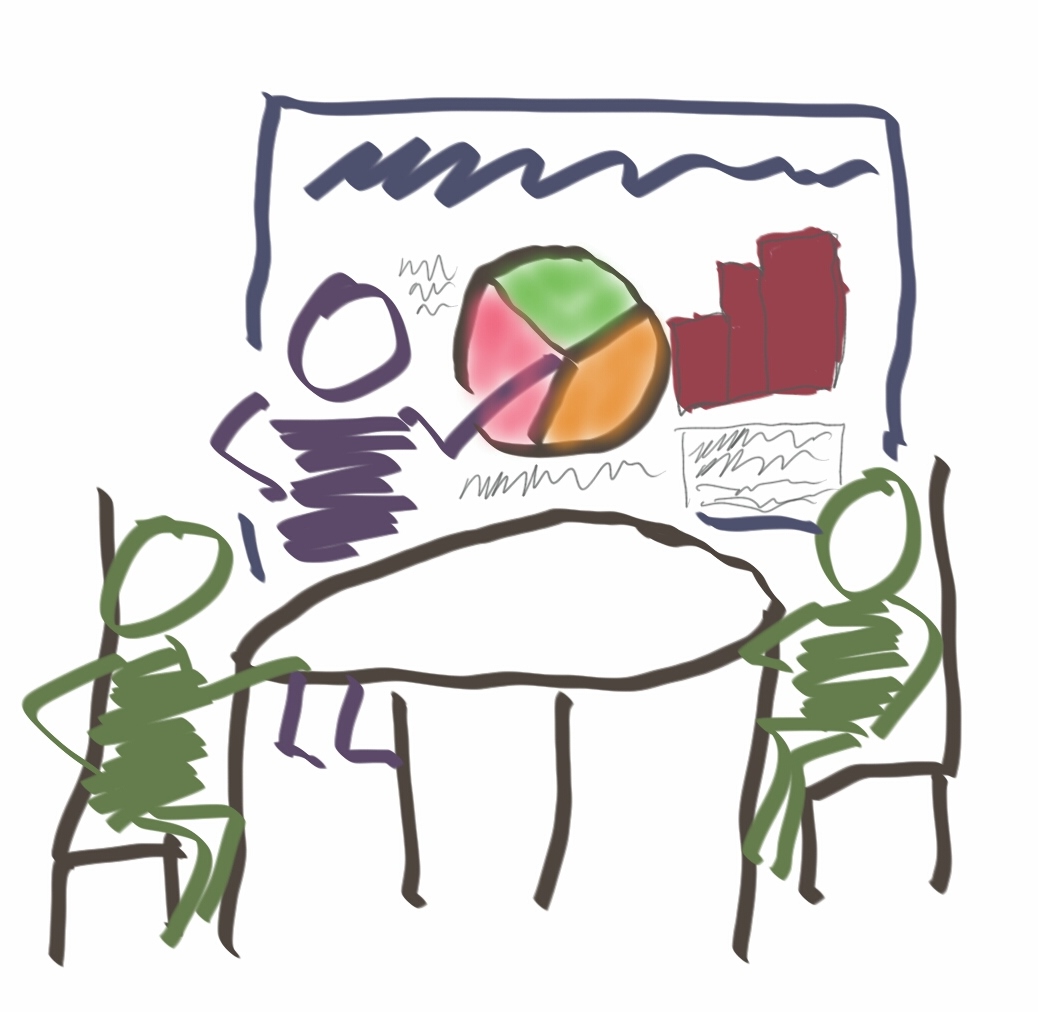
A beautifully collated and presented deck is perfectly suited to use in a presentation – so we make the assumption that we should be creating one for a workshop as well.

What’s the Problem?

The problem is that the purpose of a workshop is to do some work – to identify issues, solve problems and get creative. If we start the session with a presentation deck, the participants will immediately focus on the presented content and not move very far from it. We might get some suggestions to fix the spelling, grammar or re-word a sentence – the focus will be on polishing the deck – not generating new content.

It can be a lot more useful to start with a ‘template’ type of deck which reflects the outcomes desired from the workshop and fill it in as the workshop progresses.

Even a template can act as a framing or anchoring bias and restrict the range of thinking – so if we are after innovation, it can be a problem.

So don’t try to get things perfect first time – allow for inputs, ideas and refinement – these things take time. If we do not allow the time, we miss opportunities for innovation and the quality that comes from stepping away and revisiting/reworking a piece later on.