Serendipity, Synergy and the paradox of perfection

Striving towards perfection is a noble and admirable goal, yet in the journey towards it, the ether of forgetfulness infects us all. The sad truth is we tend to forget the mistakes and errors we made as we moved towards our goal of perfection. This is shown in two major ways

1) we often show a lack of tolerance and patience towards others in our group on their own journey.

2) We seem to focus on the result not the requirements endured to get there.

The acceptance of youth and inexperience and the errors they need to make, seems to have been replaced by the ruthless coldness of intolerance, inflated ego and a general lack of understanding and compassion.

Knowledge is a wonderful thing and we often love to be seen as being knowledgeable. Yet the knowledgeable person, expert or leader often uses their knowledge like a fountain expounding information and like an over flowing vessel, often making a mess in their wake. The information that makes up knowledge does not make anyone wiser only more knowledgeable. The true wisdom is in knowing when to say something and when not to, when to help and when not to. The basic difference between knowledge and wisdom is how to use it, silence can be a far greater educational tool than providing the answers.

The journey of learning is what is truly memorable and the foundation of wisdom.

Once you have an answer, you are biased. We hold on to our answers tenaciously, fighting tooth and nail in their defence, rarely letting go of them and the more we do so, the harder and tighter we hold on to them and they us. There’s the rub, once devoted to an answer we become zealots and almost fanatical about its virtues. So in such an environment, how can we grow and develop. To quote many Hong Kong martial arts movies, “How can you learn when your cup is already full? Empty your cup.” The basic idea is that with preconceived ideas, how can new truths be discovered?

Your eyes see but they do not observe. 

Experts focus on their strengths while masters allow for possibilities to develop.

When leading, others follow but true leaders also listen.

We live in a flawed culture, we all know it but most of us seem not to even notice. Harsh words but when it comes to our daily lives we seem to expect perfection from all others but allow ourselves the benefit and luxury of compassion, understanding and tolerance.

Perfection is the goal to strive for and we all should aim to get as close as possible. Yet we mere humans are not perfect and therefore the end results of us striving for perfection often leads to less than perfect outcomes.

Look back through history and we see, a fairly recent cultural shift from destiny and the preordained, to we are responsible for our own life and all of our failings are our own doing.  “Les Miserables”. The cultural shift has been brutal, no longer can someone be down on their luck or a victim of circumstance, instead everything can be calculated, designed, controlled and predicted, we are responsible for our own lot in life.

There is a good TED talk by Alain de Botton on this subject

There were poor unfortunates and people who had a hard time of it but now they have been found wanting and therefore are losers and no-hopers. The tolerance and understanding of things beyond our control has been circumvented by the capitalistic ideal of perfection and just rewards. There is no longer room for errors, mistakes or failure and therefore anyone showing or seeming to harbour these traits is excised for the good of the “whole”.

A rather bleak view of the world but somehow for all our advances we seem to have forgotten our own humanity. I firmly believe in rewarding effort and work but I also believe that true advances don’t just happen but are often the result of many failures, mistakes and errors of judgment. It is only through these errors and mistakes that we can truly learn and grow. The individual must have a desire to develop and grow, and only through encouragement and support can this be truly achieved. Think of a small child, do you scold them whenever they make an error or do something wrong, or do you try to explain, protect and develop the individual. A strict military style may still work in the short term but ultimately you end up with small frightened children too scared to try or do anything, crippled by fear.

Is this where we want to be?

So, what about serendipity and synergy, well interestingly enough, most great advances in human knowledge owe all or part of their existence to the synergy of personalities and the events which resulted in the serendipity of discovery. So next time you’ve got all the answers and plans mapped out, take a step back and allow silence to teach and the synergy of the group find that point of serendipity…… Eureka. !!


The perils of Sound bites and the human mind.

The human ability to learn, take facts and abstract, invent and then innovate is very impressive. All these possibilities and then more so. We live in a world of information abundance, we google, we search and we condense, all with the goal to assimilate knowledge and be able to function.

The sheer amount of data, facts, ideas and interpretations of data, available to any of us, has had a profound impact upon the way we all function and behave in our day to day lives. The ‘data explosion’ impact ranges from work, socially, ‘family and friend’ and even our own development and the way we see ourselves.

Think about it, the amount of stuff we are exposed to is increasing every year, books added to the web, new research, new facts, new ideas, new concepts etc. etc… The human animal is a marvel but to cope with an inundation of information we fall back on the tried and true method of filtering the incoming data to make sense of it. We all do it and some better than others. The very process of filtering means we, collate, prioritise, group and rapidly make evaluations upon the various pieces of information bombarding our senses. The mind grasps at straws and we often jump to rapid conclusions and interpret the apparent facts according to our own experiences and world view. This is a very efficient way to process information and to be able to make informed decisions. So what’s the problem with this system of behaviour?
Now to answer this, allow me to briefly cover optical illusions.

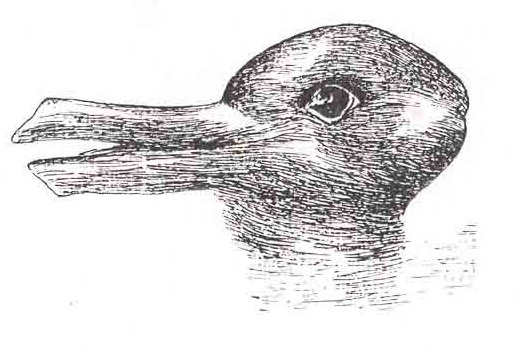
The classic examples of the brain being fooled by optical illusion such as the rabbit/duck illusion,
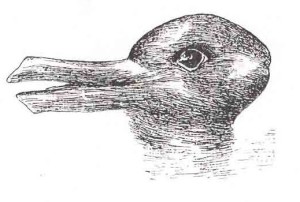
IMG_4338
are testimony that we all do it. In an effort to make sense we rapidly jump to conclusions, very handy when trying to pattern match. Evolutionarily speaking one of our greatest abilities.

Wikipedia defines an optical illusion (or visual illusion) as being characterised by visually perceived images that differ from objective reality. Information gathered by the eye is processed in the brain to give a perception that does not tally with a physical reality of the source.

There are three main types:

1) Literal optical illusions create images that are different from the objects that make them,

2) Physiological illusions that are the effects of excessive stimulation of a specific type (brightness, colour, size, position, tilt, movement), and

3) Cognitive illusions, the result of unconscious inferences. The brain trying to understand perceives the object based on prior knowledge or assumptions (‘fills in the gaps’).

Pathological visual illusions arise from a pathological exaggeration in physiological visual perception mechanisms causing the aforementioned types of illusions. A pathological visual illusion is a distortion of a real external stimulus and are often diffuse and persistent.

Physiological illusions, such as the afterimages following bright lights, or adapting stimuli of excessively longer alternating patterns (contingent perceptual aftereffect), are presumed to be the effects on the eyes or brain of excessive stimulation or interaction with contextual or competing stimuli of a specific type—brightness, colour, position, tilt, size, movement, etc.
Optical illusions are often classified into categories including the physical and the cognitive or perceptual, and contrasted with optical hallucinations.

Of all the optical illusions, the ones I wish to focus on here are the cognitive illusions.

Cognitive illusions are assumed to arise by interaction with assumptions about the world, leading to “unconscious inferences”, an idea first suggested in the 19th century by the German physicist and physician Hermann Helmholtz. Cognitive illusions are commonly divided into ambiguous illusions, distorting illusions, paradox illusions, or fiction illusions.

1. Ambiguous illusions are pictures or objects that elicit a perceptual “switch” between the alternative interpretations. The Necker cube is a well-known example; another instance is the Rubin vase.

2. Distorting or geometrical optical illusions are characterised by distortions of size, length, position or curvature. A striking example is the Café Wall illusion. Other examples are the famous Muller-Lyer illusion and Ponzo illusion.

3. Paradox illusions are generated by objects that are paradoxical or impossible, such as the Penrose triangle or impossible staircase seen, for example, in M.C Escher’s Ascending and Descending and Waterfall. The triangle is an illusion dependent on a cognitive misunderstanding that adjacent edges must join.

4. Fictions are when a figure is perceived even though it is not in the stimulus.

Now allow me to put forward the idea that as we become increasingly time poor and information burdened we increasingly begin to filter, even to the stage that we become unaware of it. This is where it can get dangerous.

I’m not talking about optical illusions jumping up at you in the workplace or in your day to day lives but I am talking about the way we all reduce information and events into “byte” sized pieces. Think about it, we dot point things, prioritise, we use jargon and, my pet hate, we make up acronyms. All in the name of efficiency and understanding. We have become a sound bite culture in an attempt to make sense and deal with all this stuff.

So what’s the problem? Well the reduction and filtering is. Think about it, reducing something means leaving something out or changing the original to a more compact form. Filtering means to sort something and then to determine what’s most important and then effectively ignoring other things to varying degrees.

When I was working in a laboratory I was told the story of a technique which was written up in a scientific journal. The Professor in our lab was trying to repeat the described technique and tried repeatedly, only resulting in failure. He followed the outlined procedure to the letter but to no avail. He ended up deciding to ring the parties concerned and found out that they had actually written in their original paper, that after a certain step in the process, they had gone to lunch for 2 hours. The scientific journal thought that this was not needed and removed this notation from the final publication. The irony was that without the 2 hour pause in the procedure the technique didn’t work at all.

Sound bites can be just as dangerous because often you don’t know what has been filtered out and things can be taken out of context.

To highlight just how misleading sound bites can be, consider an ecological study conducted by a friend of mine. He was collecting data on the kangaroo densities in a particular area and some of the variables which he looked at included vegetation type, terrain, lightning strikes etc. Now when he processed the data statistically there was a very strong positive correlation between the number of kangaroos and the number of lightning strikes. We joked that kangaroos obviously sprung up from lightning strikes; ridiculous but supported by the statistics. The real reason was that lightning strikes meant that a tree was burnt or a fire started. This meant that the native vegetation sprouted regrowth, which was tender and plentiful attracting the kangaroos into the area. So without the extra information about fire and Australian ecosystems the data could be misinterpreted.

I propose that in the course of dealing with an influx of information by reducing it to dot points, catch phrases and sound bites, we can filter things to the extent that their true nature can be lost.

I also think that this culture of sound bites can lead to ambiguity, distortion, paradox and even fiction, like cognitive optical illusions.

So next time, you’re making sense of information or trying to convey and teach, remember to check if any of these are possible :

1. Ambiguity – Can your abridged version have alternative interpretations or be perceived in more than one way?

2. Distortion – Are any parameters you’re touching upon, affected by how you choose to focus on them?

3. Paradox – Can your abridged version lead to a cognitive misunderstanding resulting in a paradoxical or impossible conclusion?

4. Fiction – Can your abridged version be perceived incorrectly?

So when you’re tempted to sound bite a concept or idea just remember Benny Hill “Never Assume because you make an Ass out of U and Me”.

Often clarity is aided by multiple perspectives (yes my sound bite).

Sound bites work because the brain is driven to define reality based on simple, familiar objects, it creates a ‘whole’ image from individual elements but this is also a potential problem. This is the reason taking them out of context can be very dangerous and some people do it on purpose to discredit valid concepts or people… a slippery slope.


Appendix

Three main types of optical illusions explained:

1) Literal optical illusions create images that are different from the objects that make them,

315px-allisvanity
One of the most well-known literal illusions is the painting done by Charles Allan Gilbert titled All is Vanity. In this painting, a young girl sits in front of a mirror that appears to be a skull. There isn’t actually a skull there, however, the objects in the painting come together to create that effect.

2) Physiological illusions that are the effects of excessive stimulation of a specific type (brightness, colour, size, position, tilt, movement)
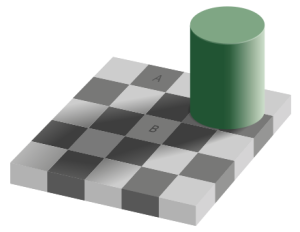
IMG_4364
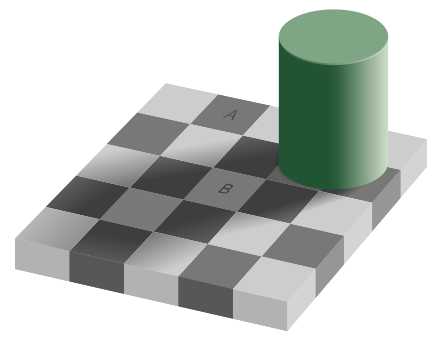
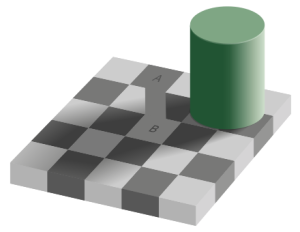
The checker shadow illusion. Although square A appears a darker shade of grey than square B, the two are exactly the same.
IMG_4365
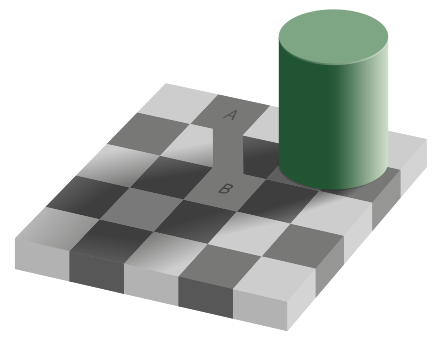
Drawing a connecting bar between the two squares breaks the illusion and shows that they are the same shade.

IMG_4366
In this illusion we see square ‘A’ and ‘B’ as not the same colour, but when the image puts the two square next to each other; they do appear to be exactly the same colour.

3) Cognitive illusions, the result of unconscious inferences. The brain trying to understand perceives the object based on prior knowledge or assumptions (‘fills in the gaps’).

345px-my_wife_and_my_mother-in-law
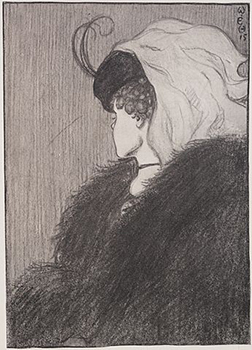
Cognitive Illusion Image – My Wife & My Mother-in-Law. Do you see a young woman or an old lady?

Wikipedia Optical_illusion
Study.com Lesson What are optical illusions; definition; types
Lecture-optical-illusion-perception
Wikipedia Sound_bite
Sound Bites

If you take only one thing away from reading this post – it is a caution to be very careful with taking only one thing away from any interaction.

We are evolved to filter information so that we only need to focus on things that are important to us – that’s why painters can put a few brush-strokes on a canvas and we can interpret it as a person walking on the beach in the distance.

Person on BeachWe filter without realising it – if we did not filter, we would be overloaded with information and find it very difficult to proceed.

When we have a conversation with someone, we imagine that they understand everything that we say in the way that we intended for it to be meant. The only thing that we can be certain of, in fact, is that the person will have interpreted what we said in the way that made sense to them. Of course what makes sense to the other person might or might not be aligned with what we actually intended.

One time, I came away from a conversation wondering why the person had started to debate the pros and cons of scrum when I had been meeting with them about something else. On reflection, I realised that my job title at the time contained the word ‘Agile’ so that person thought that I was only speaking about scrum teams and the delivery process. It was likely that the other person had a very different definition of agile – mine is a very broad one and includes Lean, Cynefin, Design Thinking and many other useful ideas and approaches. Others might define agile as ‘scrum’ and not much more for all sorts of reasons. This means that the other person was filtering my part of the conversation through a ‘Kim is here to talk about scrum’ lens which led to a complete misinterpretation of what I was asking about.

How does this relate to the title of the post ‘Sound Bites’?

We in the Lean and Agile communities have discussed and investigated many concepts and are in the habit of using short descriptions for very complex ideas. Within the community, I can say something like ‘I like to use the Cynefin Framework to help me determine which approaches are compatible with the system that I am working with’ and lots of people would understand what I meant to say. But I have spent a lot of time reading about these ideas, attending conferences, speaking with experts and trying them out so the following terms are loaded with deep meaning;

  • Cynefin Framework
  • Approaches
  • System

These terms are at risk of becoming ‘sound bites’ – the main thing that an audience hears and therefore believes is the main message. They could then try and apply one of the concepts, or an extrapolation of these ideas and end up with a completely unexpected result.

This is not the first time ‘sound bites’ have happened in our human history. For example, Bob Emeliani wrote a great post recently about Frederick Winslow Taylor and how people partially applied his Principles of Scientific Management and ended up with a sub-optimal result.

What can we do about the problem with ‘sound bites’?

We need tailor our conversations to our audience. In a group of deep experts, it is fine for us to use our shorthand terms and jargon – but in a mixed group or with non-experts, it is as if we are teachers providing all the answers to students and not teaching them how to learn – so our words are ripe for misinterpretation.

Now that you have read this post and therefore interpreted it in your own ways, I would be very interested to hear about your experiences with sound bites, or what the term ‘sound bites’ means to you.

Please leave a comment or find me on Twitter: @kb2bkb

Efficiency may be a poisoned pill waiting to be swallowed?

No process or action can become 100% efficient without negatively impacting the surrounding processes or the interconnections which make up the whole.

This idea can easily be seen the following examples

1) A production line in a manufacturing plant; at the beginning the parts are loaded onto a conveyor belt to be assembled at each point along the assembly line. If the parts are loaded onto the conveyor belt with the “highest efficiency” then the whole production line eventually bottle necks under the inundation of parts. So many parts could be loaded at the beginning of the production line that the conveyor belt can not even move the physical weight of the initial parts. Assuming that the conveyor belt can move the massive load of parts to the next station then this process will become the bottle neck.

The basic fact is that the simplest tasks can be made so efficient that they can actually begin to put loading pressure upon the more “complex” processes or actions in the work stream.

2) In teaching the most basic definition is to expose students to ideas and facts. Efficiency in teaching can be attained by “giving students the answers”. The students now have the end result in the shortest possible time therefore highly efficient. They can now regurgitate back the answer at will and all is well, in “efficiency land” but at what cost?

So how is the second example negative?

The student has taken a shortcut to get the answers but has been robbed of the journey of self-discovery and right to comprehend the concept in their own way. Why is this important? The simple and undeniable fact is that not everyone understands things the same way, we all see the world differently and our minds grasp concepts in varying ways. In teaching, the fact is that no matter how good the lesson plan, different students will pick up on different points. You will often experience the influx of questions from students trying to make the concept (lesson) part of their knowledge. This is why varying the types of examples and alternate strategies to get the concept across is very important in my opinion.

I have personally run into the darker side of “giving students the answers”. The end result may be reasonably successful at the targeted level, say high school biology but once the student enters university the cracks often appear in that the students don’t seem to comprehend the underlying concepts of the ideas or have even been taught incorrectly by a teacher who themselves had a flawed perception of the fundamentals. This type of rote learning is efficient only to a degree and at a specific level. The sad truth is that only when you appreciate a concept or idea from multiple angles (perspectives) do you begin to comprehend and understand its true nature. Efficiency in conveying ideas and facts lay the foundations for future cracks in comprehension.

Economy of scale, bigger is better, diversify and “expand or perish” are familiar concepts, so much so that we just accept them without question. We rarely question the wisdom or trade-offs these catch phrases and their core philosophies entail.

The common approach is to find something to make more efficient, these are commonly the simplest tasks in a chain. To focus on these easily measured and easily modified processes seems beneficial but like in biochemistry once you effect the level of one chemical entity, the chemical systems equilibrium(s) are affected because of their interconnection.

When focusing on efficiency, keep in mind that focusing the “laser of efficiency” upon a certain task may cause adverse effects due to the cascade effect of proximity.

Final thoughts for now.

What if the efficiency becomes detrimental to the overall wellbeing of the whole? Where are the tip points, the hysteresis, and the “endocrine system” of an organisation? Difficult answers to simple questions. The problem we face when trying to find and answer these questions is that humans work in linear time, 20/20 hind sight, we often only become aware of things after they begin to happen and then we tend to react. Not a bad evolutionary response, fight or flight; but how can we stretch past this and see into the whole.


Striving for efficiency can only be a good thing, right?

Yet this is not always the case, consider that the problem may not be the striving towards increased efficiency but the materials utilised in striving for it. No matter how hard we try, the basic truth is that any process in which people are involved in, has inherent limitations because of the human elements.

It is interesting and paradoxical that the human animal to function efficiently must have periods of rest and even diversion. Have you ever pulled an all-nighter to complete a project due the next day? The result is fatigue and usually not the best work. Side effects include emotional shifts (moods) and a distorted view of the finish result.

Well now extrapolate that to a solid 6 days with only 6 hours sleep and 3 of those hours on the very first night. Yes it can be done, no I don’t recommend it. The work becomes numbing and often and luckily the higher functioning work which involves higher mental skills such as thought are in the first days. The result is very sever fatigue and a case of diminishing returns, where version control becomes a haze and the final piece of work suffers from the lack of a clear view. The human body can be pushed but it pushes back hard, after such a task it takes months for the body to return to a state of normalcy.

OK the above extreme example is ridiculous but highlights the fact that tasks can not be optimised infinitely.


Efficiency and Transition Points

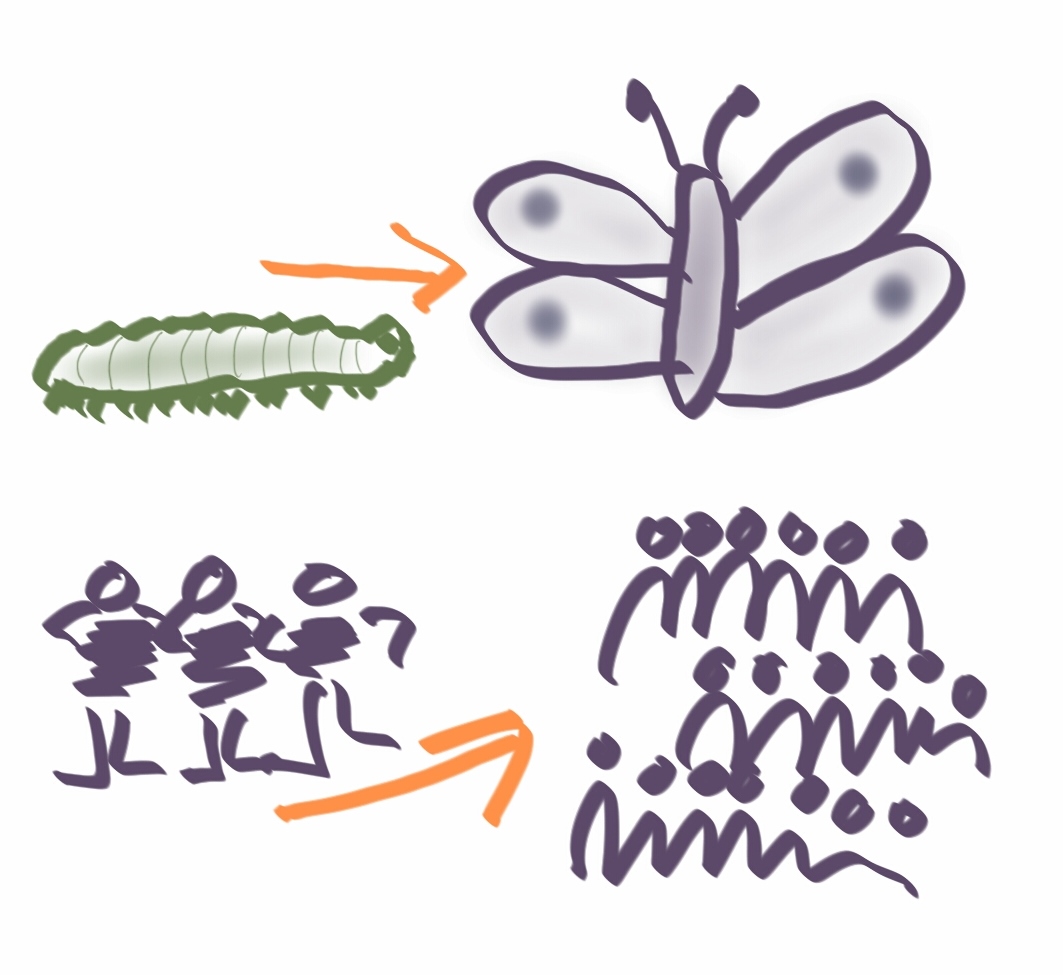
For the purposes of this post, the term ‘transition point’ means any point where something changes from one state to another. Some examples are;

  • A caterpillar changing to a butterfly
  • A company growing from a start-up to a large business
  • Developing a skill from basic to competent and then to expert would be considered at least 2 transition points

Transition PointsWe assume that it is easy to anticipate when transition points are going to happen – this is because for our whole lives up to now we are looking into the past and it is easy to see when transitions occurred. But this is a fallacy – we are using the benefit of hindsight to observe when the transition happened and in many cases we could not have estimated when the transition would occur beforehand.

Transition points can impact efficiency – I harvested some damson plums this morning and was pushing out the stones with a cherry pitter. Easy for 10-20 plums – but I was doing over 100 of them. The transition in this case was the scale of fruit that I was preparing – I found that I was picking up the cherry pitter, then putting it on the other side of the sink, then picking up a strawberry huller to get the stone out. I found that putting down the cherry pitter on the same side of the sink that I was working on instead of the opposite side sped up the process.

The same thing happens at work – imagine a small company dealing with incoming traditional mail – almost anyone can manage it on top of their normal job because only a small amount would get delivered each day. But it is easy to see a difference in a large company – often there are several people who have full-time jobs sorting and delivering the traditional mail and parcels. When did the transition point/s occur? How did they get detected and then managed?

When we notice problems, these can be symptoms of a transition point in progress – I noticed the delay caused by reaching to the other side of the sink and created a counter-measure to reduce the distance to put down and pick up the tool. But imagine that someone delivered a lot more plums to me – how would I process them in that case? The 100 or so this morning took me about 30 minutes to pit. The process I used today would be very inefficient in a plum jam factory – how many other things are we doing in ways that we always have and imagine them to be efficient? Perhaps an external factor has changed that we have not noticed yet and our ways of working have therefore reduced in efficiency.

The term ‘counter-measure’ in the Lean sense is starting to grow on me. It is a good term to use instead of ‘fix’ because any action that we take to address a problem is likely to become less useful later on and we will need to create and implement a new counter-measure at that time. It takes the pressure away from finding the perfect solution and focussing instead on one that is good enough to address the issue that we are observing, implement it and then observe the effect of the counter-measure – adjusting again when needed.

In Summary

  • Efficiency can drop if we apply the same ways of working when a transition point occurs
  • It is easy to see the transition points afterwards, but hard to anticipate them – use problems and issues as indicators of transition points
  • Using the term ‘counter-measure’ instead of ‘fix’ can be helpful to recognise that future transition points will happen and a new counter-measure will need to be developed later

Of course, this post has been using the term ‘efficiency’ which is not the same as ‘effectiveness’. We also need to be aware that the effort we are making is towards a valuable outcome. In the case of my plums, I am just about ready to put the cooked plum paste into a container – this is valuable for me, but not for people who do not enjoy the taste of plums. For such people, it might have been just as good for me to put the plums into a compost bin – but then I would not have had to remove the stones – so being more efficient with that process would have been wasted efficiency.

The Doppler Effect and Time Management.

Wikipedia states that:

The Doppler effect (or Doppler shift) is the change in frequency of a wave (or other periodic event) for an observer moving relative to its source. Named after the Austrian physicist Christian Doppler, who proposed it in 1842 in Prague.

Its effect can commonly be heard when a vehicle approaches, passes, and recedes from an observer. The frequency of the vehicle or horn etc. is perceived as higher when received during the approach compared to the emitted frequency, identical at the instant of passing by, and lower when moving away (receding).

When the source of the waves is moving toward the observer, each successive wave crest is emitted from a position closer to the observer than the previous wave. This means that each wave takes slightly less time to reach the observer than the previous wave. Hence, the time between the arrival of successive wave crests at the observer is reduced, causing an increase in the frequency. While they are travelling, the distance between successive wave fronts is reduced, so the waves “bunch together”. Conversely, if the source of waves is moving away from the observer, each wave is emitted from a position farther from the observer than the previous wave, so the arrival time between successive waves is increased, reducing the frequency. The distance between successive wave fronts is then increased, so the waves “spread out”.

So what does this have to do with time management and projects etc……..?

Well I have never met anyone who precisely manages their time. Sounds bad, but unfortunately true. Think about it, we can assign time estimates, we can have an idea of how long tasks will take but we actually can never give a precise time stamp such as that task will take 1:13:18. This is what I mean by precise.

I don’t expect anyone to be able to accomplish this completely but we can improve the situation if we become aware of the “Doppler effect” when we engage in tasks. For example how many of us have said “I can help, you! Should only take a couple of minutes.” Have you ever helped someone with their computer? Those couple of minutes become hours because once engaged in the task at hand, time seems to skew. Unexpected problems pop up, the task was actually more convoluted, complex, complicated than you expected, you expected it to be something else; or you just honestly thought it would take only a short time and seem to get involved and lose track of time when you’re working on something.

I personally tend to do the latter so much so that there is time, and Steve time when I’m working on something because you don’t stop until it’s finished.

So what of the Doppler effect? Well, when not engaged in the task and looking at it from the outside, observing the task calmly in the distance, no stress, no pressure almost serene. Our perspective of the task seems small, like a car in the distance there’s no urgency and it seems small, almost insignificant.

When the task is at hand, the actual work takes on a sense of urgency and true scale. The task takes on its own dimensions, not those predicted or estimated by us but its actual form, warts and all. The task becomes enveloping and the most important thing at this point in time because we are engaged. We lose track of time, schedules can slip and we even chase rainbows down blind alleys because we try to make the task fit into our previously conceived notion of what it was. The end seems so far and the mountain to climb can seem so high that we may tend to procrastinate, avoid and generally hide from the fact that the task was not as it seemed in the beginning.

When the task is approaching the deadline or completion, things seem to move at a quicker pace, the time left on the task or project seems to evaporate. Interestingly the tasks can become more defined and therefore accomplished with greater ease, the skills have been honed or acquired, the nature of the true task has begun to show itself and the end is in sight and happily embraced.  However, this may not be the case.

What is this all about; well we tend to colour our perception of how long things will take, we often underestimate the tasks at hand and therefore the required effort, we can also overestimate (fudge) the timelines and effort involved in a bid to give ourselves a sense of control. Often people will rise to the occasion and work overtime, through lunch and even weekends, when in the belly of the task, but should we then take these efforts and extrapolate that our fudged metrics and greyed opaque time constraints are accurate or based on reality? These problems are universal and we all do it to some degree but projects and tasks are not uniform pieces of work, they exist like plum puddings, patches of smooth consistency with areas of varying densities (raisins, mixed peel etc.), these areas are tasks which are more complex, complicated or just unknown.

So how can we deal with this?

The first thing is to be aware, most projects and tasks are not consistent in effort or degree of difficulty. The ability to examine and explore the project, sift out more difficult tasks and subtasks and prioritise them is beneficial. Striving towards the framing or putting guidelines in place to aid and clarify is also very helpful. And finally the awareness that all projects and tasks are their own “animal”.

Biologically speaking animals and plants are grouped by their similarities and teased out by their differences. Even in a population of a single species there is variation. Surely tasks and projects are no more diverse, each may share similar traits to others but they are never really the same. Even if a carbon copy project was run, the outcomes would vary because the time it was undertaken would be different, the staff, the economic climate etc. etc.… could also vary.

The environment and our position in it, effects perception, this is a simple idea but difficult to enable. The fact in any organisation is that tasks are divided up to help efficiency and productivity. This is a tried and true approach yet when you have a disjoint between groups, all hell can break loose. Imagine a typical company with management, staff and silos responsible for certain activities such as programming, sales, administration etc. you get the idea. Now a disjoint would mean by definition that these silos or groups would not share the same world view as each other, they may be similar but never the same. The focus of each group would be different by the very nature of the organisational structure. Fertile grounds for a Doppler shift, differing perspectives.

Say the management wish to grow the company, sales are motivated to sell by means of commissions (more money for them), the programmers just want to code and be left alone, the administration wants clear view and control, over all and sundry. One organism pulling in different directions. The idea of being a team player is raised on high and touted as a company value and all is well?

The Doppler effect by its very nature means that each group will see their environment differently and although the same entity, perceived differently. The real dangers come from the lack of awareness between silos, the sales reps up sell, management wish to expand and grow and the “grunt work” is done by the people engaged at the coal face, coding etc. They are the best ones to gauge the true nature of the tasks at hand and the capacity for growth. Sure, stretch targets are good, people will often rise to the occasion but if stretched too far or too quickly, errors and catastrophe are around the corner. If the “grunt workers” in the company are working long hours in overtime, through their lunch breaks and on their weekends then the sales reps (on commission) and the management team are not team players, in my opinion.

The differing perspectives (Doppler effects) are distorting the true situation and we all should be aware of these effects.


Visualising Certainty in Project Estimates

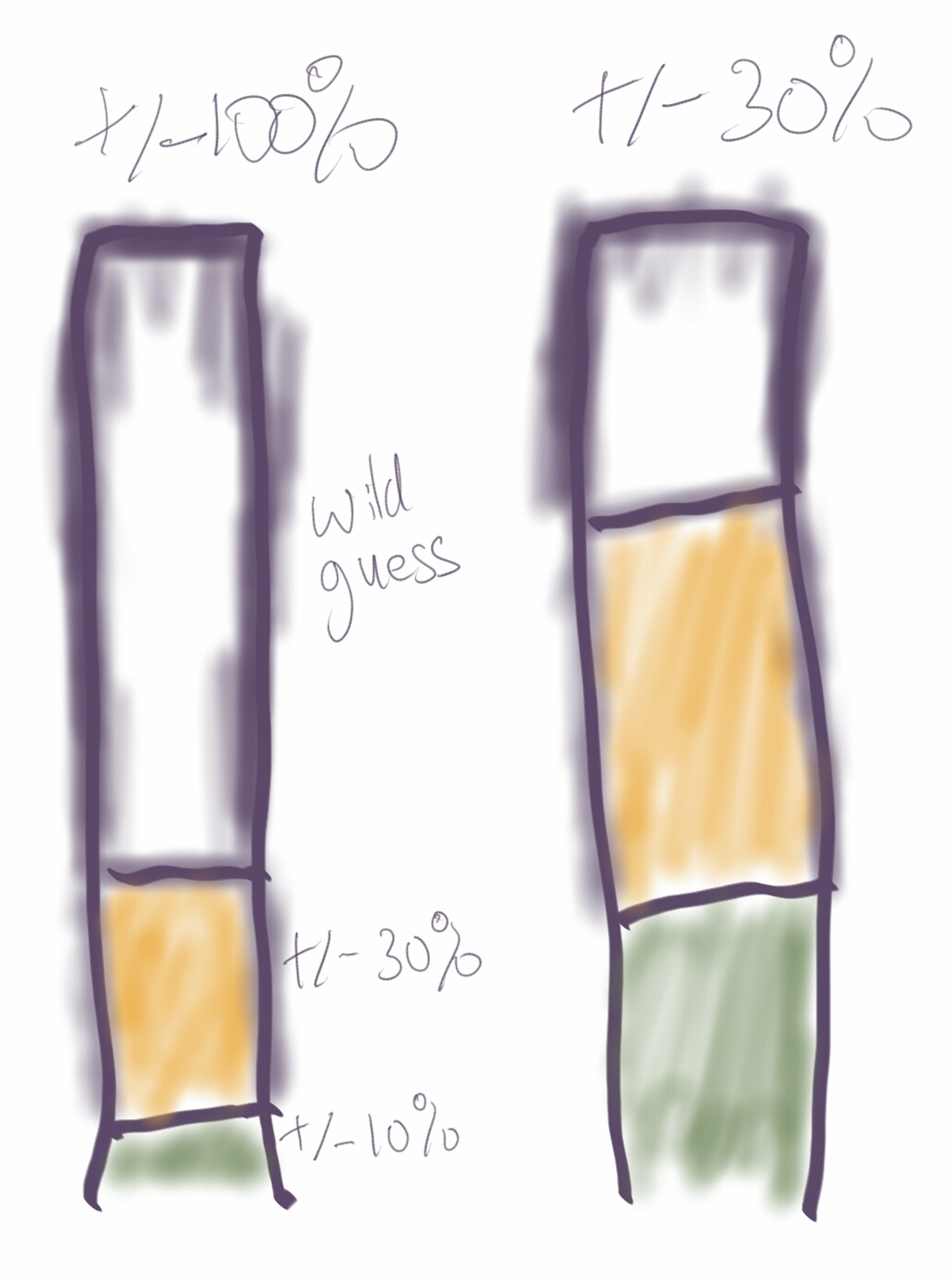
When we are scoping out a project, we are asked to provide estimates for time and cost to certain confidence levels. At the start it might be +/-100%, then +/-30% and then +/-10% (or fixed price).

What we are doing is spending money and effort in order to learn more about what we are going to deliver before we get started on actually delivering it. Using a blanket level of confidence such as +/-30% could be introducing more risk into the project because most of the things that we work on actually have subset levels of certainty. Even at the very start of a project, when we are asked for +/-100% – some of the work will have +/-10% certainty, some +/-30% and the rest will be a bit of a wild guess (+/-100%). The risk that we are introducing by treating the whole estimate as a wild guess is that we will end up spending a lot more on investigation to get to the next levels of confidence than we really need to spend.

There is another way to express our levels of confidence. Imagine a stacked bar graph that could show the amount of work at the different confidence levels. At the start, and what we would call as a +/-100% level of confidence, it might actually be a very skinny layer at high confidence (+/-10 %), a bit more at medium confidence (+/-30%) and a large amount at wild guess level (+/-100%). Depending on the type of scope falling into the three different sections, we can then make better decisions about the remaining work to estimate the project and whether there is value in starting some of the higher confidence work earlier.

Fuzzy stacked bar graph Even when we have an overall estimate to +/-30%, we will still have subsets of scope sitting at the high certainty and wild guess levels also. By expressing the estimate as an overall +/-30% we are hiding crucial information about the project which could be used to make better decisions, be indicators of untapped opportunities, or risks.

For example, if we are looking at a project estimate that looks like the bar graph on the right in the above picture, we could have a good discussion about the amount of effort required to drive out the uncertainty from the wild guess components. It might be the case that we should start the other components first because that work will inform the wild guess components or completing some of that work will make it easier to determine some aspects of the wild guess work. Without this type of visualisation, we will treat the entire scope as still only having medium certainty and might start some work prematurely or delay useful work and potentially over-invest in effort to gain more perceived certainty.

Observation, Perception ……

The set and forget, out of sight out of mind and even your greatest strength can be your weakness are all very familiar phrases to most of us. So what does this mean to most of us in our day to day lives?

The greatest thing about programming is the fact you can create something from nothing; all you need are the basics, computer, language and time. No other thing we create can be made from such a point of nothingness. The wood worker requires timber and physical tools, the metal worker metal etc. but when it comes to creating software you can create everything even the tools. This virtual world is liberating and basically unrestricted except by our own limitations. This freedom from the physical world is its greatest strength but also its greatest weakness.

We are physical beings and as such experience our environment by our senses, touch, smell, sight, taste and hearing. Because of this we relate better to things that share our way of experiencing the world. People relate better to cats and dogs (furry mammals) than they do to fish. Many fish are doomed to die because they do not experience and interact with the world in a similar manner to people.

The usual pets such as cats and dogs breathe air; can vocalise (meow or bark) to get attention and live in the atmospheric environment as we do, which means that smells can be shared by both people and pet. This last one seems strange but the fact is when the kitty litter tray is dirty or the pet has made a mess people can smell the result easily. In the case of fish, however, when the water in a fish tank becomes “stale” from their waste products or from over feeding, the water does not smell bad to us until it becomes really toxic. The person looking after a fish tank often looks only at water clarity as a means of gauging the condition of the tank, the problem with this is battery acid is also clear and yet toxic. The fact we do not live in water means that this environment is rather foreign to us and therefore we can naturally sense only some of the important parameters required for fish to live. This is why many fish die due to our inexperience as fish keepers.

So how does the fish keeper overcome the “out of sight out of mind” dilemma of fish keeping, the answer is actually rather simple, they use test kits to check pH, ammonia, nitrite, nitrate, alkalinity and many more parameters depending on the goal of the tank. This doesn’t really sound simple does it? But the actual fact is the fish keeper uses all the above tools to gauge the state of the aquatic environment, yet his greatest ally is in fact the simplest which is regular water changes of 10 to 20 percent usually weekly. Yes, that’s right, regular maintenance is your only real ally when you are dealing with a foreign or alien environment.

So what does fish keeping have to do with programming? Well the fact the virtual world our programs live in is a completely alien or foreign environment means that we are not naturally aware of the state or conditions in this environment without using tools to test and monitor it. The regular water changes may be considered regular updates or upgrades. The set and forget environment of software is its greatest strength and also its greatest weakness. Just like a fish tank we will only notice the bad (really bad) water quality when it smells foul and this is usually too late. Similarly we only tend to notice software when it breaks.

If you don’t like fish then maybe the aircraft industry is a better analogy for you. The fuselage of aircraft undergoes many stresses during normal operation and basic metallurgy tells us that if metal is bent back and forth many times, it will eventually fail. The resulting metal fatigue is usually invisible to the naked eye and to monitor it requires special equipment and expertise. The cost of which would be prohibitive if tested every flight or every week. This is where the aircraft manufacturer specifies maintenance schedules for testing and replacement of specific parts. Next time you fly think of this and think about if the plane was your software would your maintenance find the metal fatigue?

Managing Constraints

Tasks and activities are easy to manage – we see that a job needs to be done, schedule some time for it and then do it.

Queues are easy to see – waiting in line to pay for some goods when we go shopping – or waiting in line to see a popular tourist attraction. Waiting in queues like these is a good time to ponder about why the queue is there and how it could be better managed. Could the shop hire some more cashiers? Could the tourist venue allow more people through at once by setting out the attraction in a different way?

What about the queues that we cannot easily see such as those in our everyday work?

One thing that seems efficient is a regular set of decision-making meetings such as review and approval to proceed with an activity (like recruitment or a project). There could be a better way to manage these decisions – or are these regular meetings actually the most effective way to do it?

How many of us have rushed a presentation together to get it into the next cycle for a decision meeting? What might happen if the decision could be made as soon as we have brought together the information needed to make that decision? Would we have less of a sense of urgency and take longer to do simple things? Would it take less time because we know that the decision will be made as soon as we are ready for it?

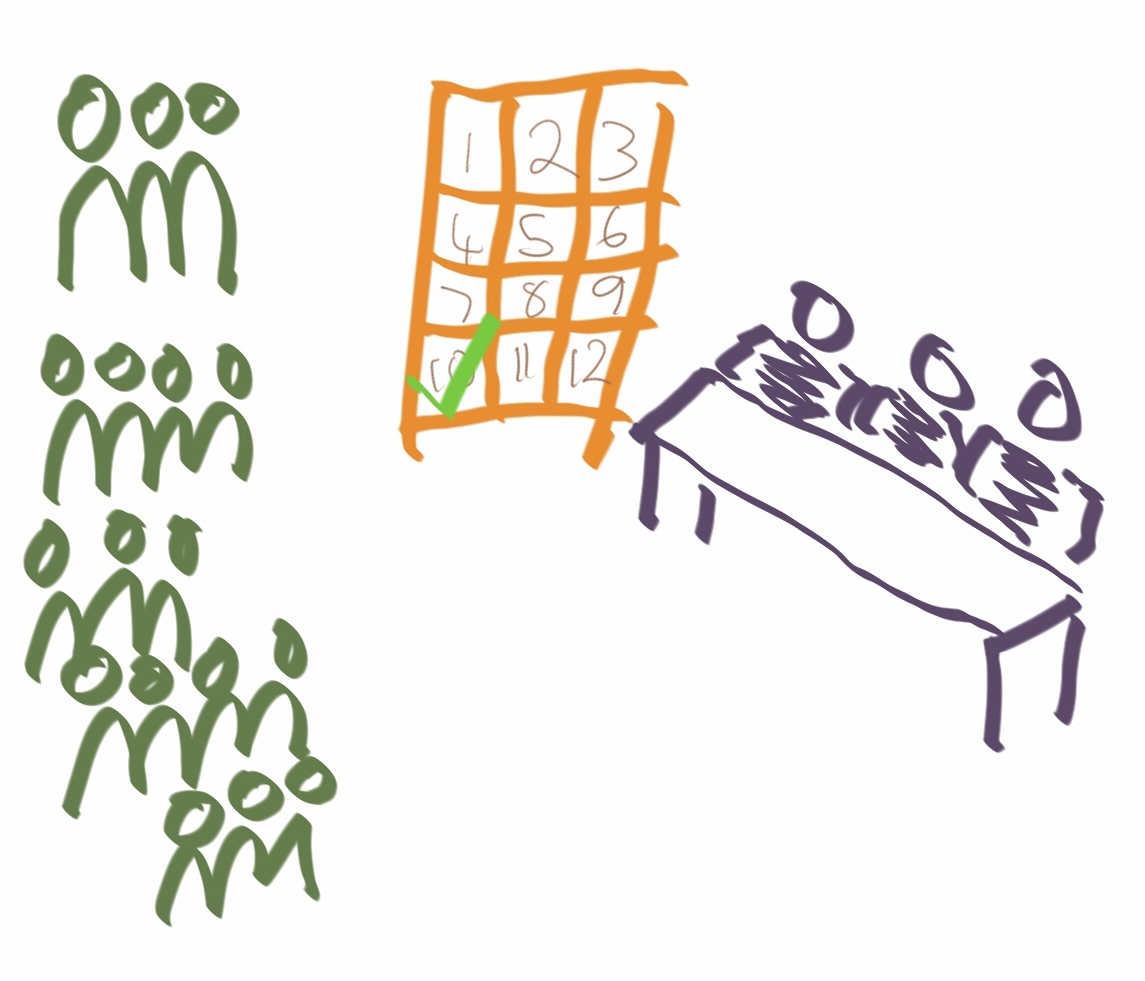
The decision to proceed or not is a constraint – up until that time, we are not certain that the project or other action will go ahead. By holding a regular meeting for the decision-making, we are making efficient use of the decision-makers time – but we are introducing queues into the process. Imagine that there will be 5 project ideas presented at the next meeting – all 5 have different sets of data that they need to gather in order for the proceed or not decision to be made. This data-gathering will have different lead times and each project will actually be ready for the go/no-go decision well before the meeting – so the length of wait-time in the queue will be different for each of them. How many of us record these wait times? Those things that remain invisible cannot be managed – people will be waiting on the decision-meeting before they can do the next set of useful actions. We could have 5 teams waiting on one meeting with senior decision-makers – because that is the best way to use the time of those decision-makers.

5 Teams WaitingConstraint management is hard to do because it is very hard to notice the constraints. We get used to it taking a certain time to do things and waiting for the next decision point – because that’s how it’s done and it appears to be efficient.

There are a lot of other constraints out there waiting to be noticed – the clues are there when our colleagues roll their eyes or complain about something. We can empathise with them and move on – or we can empathise and then dig a bit deeper.

  • Is this a part of a pattern?
  • Do other people also complain about it?
  • How can we measure the things that people are complaining about?
  • If we could measure them, what would we expect the measurements to be in order to validate or invalidate those complaints?
  • If we are not already capturing the data, why?

Next time you are planning work – notice if you are planning activities, tasks or constraint management. Planning some time each week for observation sounds like a good idea – only by looking at something for a while and reflecting will we find ways to improve.